
![[Media Report] Creative Design Competition for Air Conditioning Copper Pipes, Water Pipes, and Electrical Wires Application - Nationwide High School Competition](https://www.yankey.com/upload/news_list_pic/圖3__23K29Ja5qY.jpg)
![[Media Report] Compal Electronics, Yankey Engineering, and Orient Semiconductor Electronics Jointly Provide Scholarships to Cultivate Master's-Level Talent](https://www.yankey.com/upload/news_list_pic/圖2__23K29ElEsm.jpg)






依據歐盟施行的個人資料保護法,我們致力於保護您的個人資料並提供您對個人資料的掌握。
按一下「全部接受」,代表您允許我們置放 Cookie 來提升您在本網站上的使用體驗、協助我們分析網站效能和使用狀況,以及讓我們投放相關聯的行銷內容。您可以在下方管理 Cookie 設定。 按一下「確認」即代表您同意採用目前的設定。
15
15
Sep
2026
Media Coverage
Integrating Over a Hundred Utility Systems Hidden Within a Building — The Invisible Infrastructure Behind Semiconductor Yield
Source: 104 Job Bank
https://blog.104.com.tw/yankey/
When people talk about semiconductors, the focus is usually on chips, manufacturing processes, and production equipment. Yet before any equipment can begin operation, a much larger — and often overlooked — infrastructure system must first be put in place.
How can a stable power supply be ensured? How are temperature, humidity, and cleanliness maintained inside a cleanroom? How are ultrapure water, gases, and chemicals safely delivered to the correct locations? And how are wastewater and exhaust gases properly treated after use?
For a semiconductor fab, these systems are not merely supporting facilities. They are essential production conditions that determine whether manufacturing lines can operate smoothly and may even directly affect product yield.
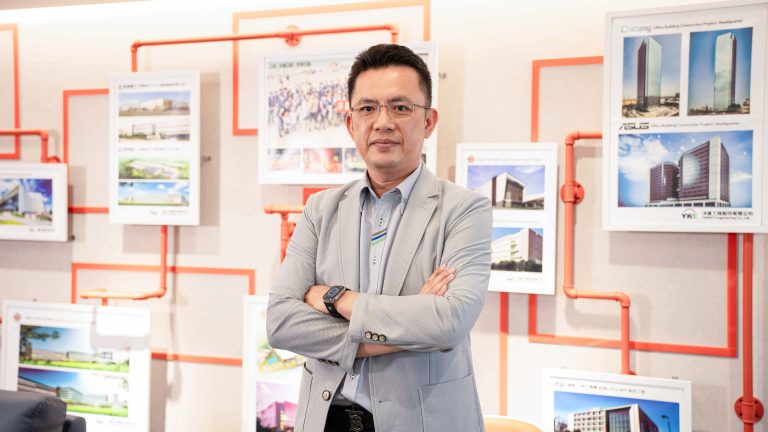
Mr. Su Chi-Chang, Vice President of Yankey Engineering, explains that the company’s role within the semiconductor supply chain goes far beyond simply “building the factory.” Yankey acts both as a builder and as a long-term partner supporting subsequent facility operation and maintenance.What truly matters is the ability to safely deliver a facility within a limited timeframe, establish a stable manufacturing environment, and respond rapidly to evolving customer requirements and design changes.
Whether a Semiconductor Fab Can Operate Depends on More Than a Hundred Utility Systems Hidden Within It
Many people assume that once the main structure of a semiconductor fab is completed and production equipment is installed, manufacturing can begin. In reality, for high-tech manufacturing facilities, the most complex engineering systems are often hidden within the walls, ceilings, and floors.Yankey Engineering began with expertise in HVAC, mechanical and electrical systems, and cleanroom engineering. Today, its service scope has expanded to full-plant EPC services, covering Engineering, Procurement, and Construction, transforming an entire facility from an initial concept into a fully operational manufacturing site.
A project may begin on an undeveloped site, or it may involve converting an existing display-panel factory into a semiconductor fab. Regardless of the project type, successful execution requires close collaboration among civil and structural, MEP, process utility, and project management teams.Beyond building structures, power systems, and air-conditioning, semiconductor manufacturing also depends on process-related systems including ultrapure water, wastewater treatment, specialty gases, chemicals, and environmental control systems.
According to Mr. Su, a high-tech manufacturing facility may contain more than one hundred different types of pipelines and utility networks running simultaneously throughout the building. Each has its own specific function, technical requirements, and safety standards, yet all must coexist within highly constrained spaces without interfering with one another.As a result, an engineering team is not merely delivering a building. It is delivering an integrated operating environment that allows production equipment to function reliably and consistently.As semiconductor manufacturers continue to pursue energy efficiency, carbon reduction, and net-zero targets, Yankey’s engineering, design, and R&D teams must also provide increasingly advanced technical solutions that help customers reduce energy consumption.
In this way, the value of engineering has evolved from simply asking “Can we build it?” to a more important question:“Can we build it more efficiently, sustainably, and intelligently?”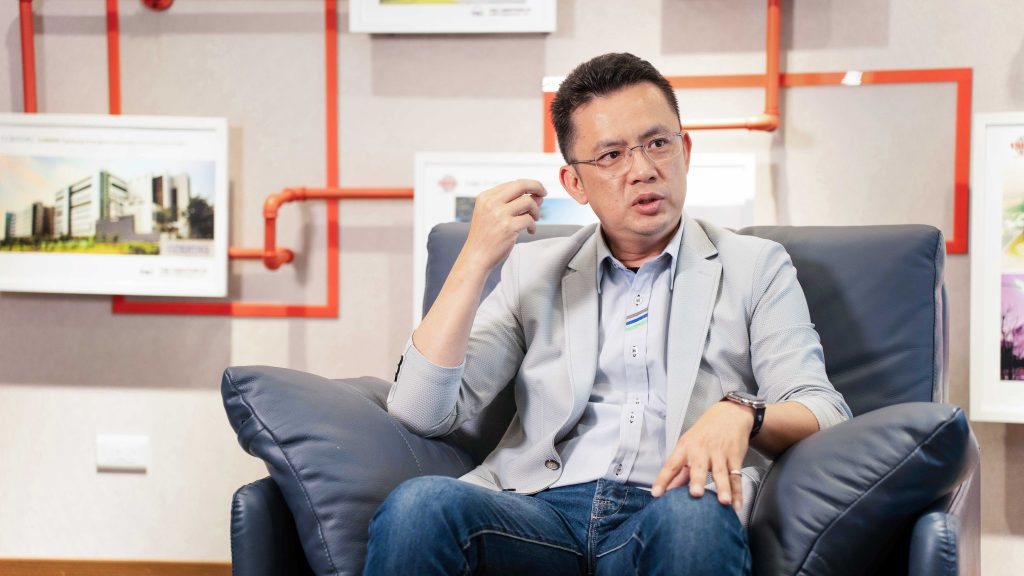
It’s Not Just Electrical Engineers — Nearly the Entire Engineering Talent Landscape Is Needed
As Yankey Engineering continues to expand its service scope, the range of talent required has also become increasingly diverse.
The MEP field requires professionals with backgrounds in electrical engineering, mechanical engineering, thermofluids, HVAC, fire protection, plumbing and drainage, and central monitoring systems. Civil construction requires expertise in architecture, civil engineering, structural engineering, and geotechnical engineering. Process utility systems call for specialists in materials science, chemistry, environmental engineering, and water treatment. In addition, there are also roles in occupational safety, quality management, and project management.In other words, semiconductor facility construction is not a career path limited to graduates from only a few academic disciplines. It is an engineering environment that brings together a wide range of technical specialties.
Vice President Su Chi-Chang noted that Yankey currently has more than 700 employees in Taiwan and aims to continue expanding toward a workforce of 1,000. Both fresh graduates and experienced engineering professionals are part of the company’s recruitment focus.For new graduates, what they learn in school provides the fundamental tools, but real engineering capability is developed through hands-on project experience. Problems on site do not occur in the same sequence as they appear in textbooks. Engineers must understand drawings, equipment, construction schedules, and the needs of different teams at the same time, while also being able to quickly identify solutions when unexpected situations arise.
Yankey Engineering does not place every employee on the same career path. Instead, it provides distinct development tracks for management and technical professionals. Those who excel in communication, coordination, and team leadership can progress toward project management and managerial roles, while those who prefer to deepen their technical expertise can continue developing as professional engineers, senior technical specialists, or chief engineers.Neither path is considered superior to the other. The goal is to help each individual find the role in which their strengths and capabilities can create the greatest value.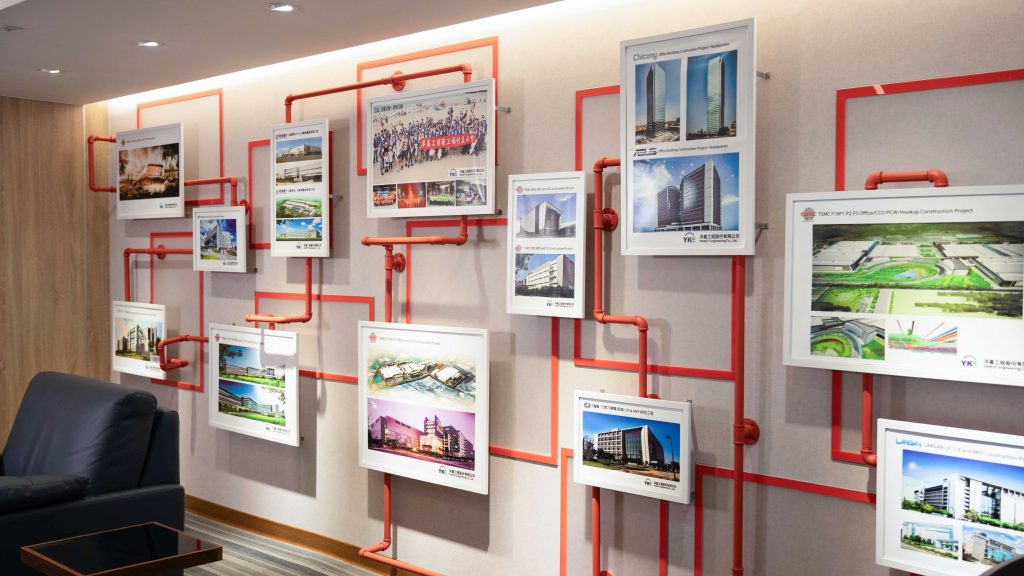
Engineers Are Building Fabs with 3D Models — While Drones Patrol the Site Autonomously
As high-tech manufacturing facilities become increasingly complex, the tools used by engineers are also evolving.Since 2019, Yankey Engineering has fully adopted BIM and Revit across its projects. Compared with traditional 2D drawings, BIM enables engineering teams to visualize pipelines, equipment, and building spaces in a 3D environment, allowing potential clashes between different systems to be identified before construction begins.
Yankey currently has more than 200 design professionals, and most of them are already capable of carrying out 3D design work using Revit. For renovation projects involving existing facilities, the team also uses point-cloud scanning to convert on-site conditions into digital models, which can then be compared directly with new design plans.
As projects progress through different construction stages, the site is scanned again so that completed pipelines and installed equipment can be brought back into the digital model for verification. In the past, site supervisors had to use measuring tools to inspect each location and pipeline one by one. Today, millimeter-level scanning data allows discrepancies to be identified much more quickly and accurately.Yankey Engineering is also testing autonomous drones capable of flying independently while avoiding people and obstacles. In addition to scanning and documenting construction progress, these drones can support site safety management by identifying whether workers are wearing safety helmets, protective eyewear, and other required personal protective equipment, then reporting any irregularities back to the management team.
However, smarter tools do not mean engineers will be replaced. Vice President Su Chi-Chang points out that construction sites involve far too many variables. Designs may change, schedules may be delayed, and dozens of different trades may affect one another at the same time. AI can improve efficiency, but it is still difficult for it to independently take responsibility for judgment, coordination, and real-time response.For this reason, the company also encourages employees to develop their own AI Agents. For example, some employees are using email and Microsoft Teams conversations to automatically compile weekly engineering reports, shifting time away from administrative consolidation and toward more important professional and technical issues.
In this environment, AI is better understood as an assistant, while engineers remain responsible for determining whether the answers and outputs are actually correct.
Two Months Lost from the Schedule — Yet the Delivery Date Cannot Move by a Single Day
One of the most intense pressures in high-tech facility construction is that even when an earlier stage of work is delayed, the scheduled date for equipment move-in often cannot be changed.If civil or structural work falls behind by one or two months, the teams that follow may have no choice but to shift from a single daytime schedule to two shifts, operating both day and night. If the project is still unable to catch up, the site may even move to a three-shift system, with construction continuing around the clock, 24 hours a day.
In this kind of environment, the first lesson for young engineers is not how to work faster, but how to work safely.They must keep a safe distance from heavy vehicles, stay clear of lifting operations, and fully understand every safety requirement before entering an active construction zone. Vice President Su Chi-Chang puts it simply:“You have to go home safely. That is the most basic requirement. Without that, nothing else matters.”
But engineering projects are not driven by procedures alone.When dozens of crews must work together under intense schedule pressure, whether managers truly understand the challenges faced by frontline workers—and whether they have earned the team’s trust—can directly affect how effectively the site operates.
Su recalls that when he was younger, he worked as a general laborer on construction sites alongside his father. That experience gave him a firsthand understanding of how physically demanding site work can be.
Later, when he began leading engineering teams, he often carried earplugs with him. If he saw workers performing high-noise tasks without proper hearing protection, he would simply hand them a pair.To him, taking care of people on site is not a management technique. It is a fundamental responsibility of an engineering leader.When team members feel that they are genuinely working together and looking out for one another, they are also more willing to step up when a project enters a critical phase and extra effort is required.On the surface, engineering management is about controlling schedule and quality. In practice, it is still ultimately about managing people.
From an Empty Site to a Landmark You Can Point to and Say, “I Built This”
When asked what makes engineering work most rewarding, Vice President Su Chi-Chang does not talk about job titles. Instead, he points to the sense of fulfillment that comes from seeing a completed building become a lasting part of the city.Throughout his career, he has participated in projects across Taiwan, Singapore, Japan, China, and other locations. The scale of those projects has also grown steadily—from hundreds of millions of dollars to multi-billion-dollar developments. Each completed project becomes a visible milestone in his professional journey.
There is a unique sense of achievement in watching an empty site gradually transform into an office building, shopping center, hotel, or even a manufacturing complex capable of supporting tens of thousands of workers. That feeling is difficult to capture in reports or spreadsheets.This is also what makes semiconductor facility construction different from many other professions. Engineers are not simply working with digital models on a computer. They must integrate drawings, materials, equipment, and the work of thousands of people, ultimately turning them into a fully operational manufacturing facility.
For young professionals hoping to enter the semiconductor supply chain, having the most prestigious academic background is not necessarily the deciding factor. Yankey places greater emphasis on fundamental engineering capabilities, a strong willingness to continue learning, and the ability to use digital tools to improve efficiency. Those who hope to move into management roles must also develop strong communication, coordination, and team leadership skills.
By the time the outside world sees chips coming off the production line, much of the engineering team’s work has already been completed. Yet behind semiconductor yield are the hidden pipelines and utility systems woven throughout the building—complex, interconnected, and expected to operate without error.
For people who enjoy solving complex problems, are willing to work on site, and hope that one day they can point to a factory and say, “I helped build this,” semiconductor facility construction offers a career path where professional expertise can leave a lasting mark on the city.
Related News

03
03
Sep
2026
Media Coverage
Yankey Engineering Named Among the “2026 Taiwan FINI 100 Companies”
12
12
Mar
2026
Media Coverage
Yankey Engineering × Taoyuan Local Industry Expo
![[Media Report] TPCA Collaborates with TTEO on 9/14 to Facilitate Employment Matching for Thai Sun PCB](https://www.yankey.com/upload/news_list_pic/cover__23K296haB6.jpg)
19
19
Sep
2023
Media Coverage
[Media Report] TPCA Collaborates with TTEO on 9/14 to Facilitate Employment Matching for Thai Sun PCB
![[Media Report] Taipei Okwork Expo Take Place at Taipei Expo Park on August 12th](https://www.yankey.com/upload/news_list_pic/20230815164552540__23K29nHcyn.jpg)
15
15
Aug
2023
Media Coverage
[Media Report] Taipei Okwork Expo Take Place at Taipei Expo Park on August 12th
![[Media Report] National Chin-Yi University of Technology Hosts Ming Hsiu enterpriser Networking Event](https://www.yankey.com/upload/news_list_pic/圖1 勤益科大校長陳文淵(前排左五),與明秀企業家會員在圖書資訊館6樓合影。黃奇鐘/攝影__23K295Q9hu.jpg)
01
01
Jun
2023
Media Coverage
[Media Report] National Chin-Yi University of Technology Hosts Ming Hsiu enterpriser Networking Event

06
06
Jan
2022
Media Coverage